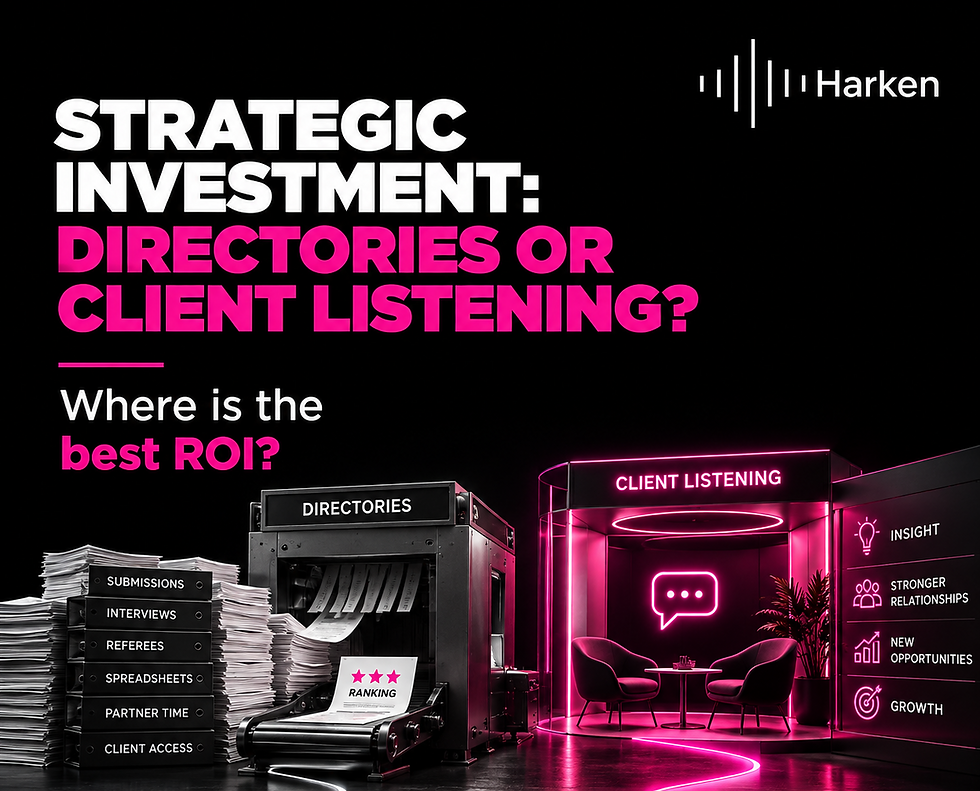
Sorry, I’m not buying what you’re selling…but I could be!
Law firms organise themselves around their expertise: corporate, employment, disputes, private client, tax etc. Naturally, marketing and business development often follow the same model, promoting practices, sectors and services to the market.
What we've all known for a long time, and what we continue to hear loud and clear from clients, however, is that this isn't how clients think.
Clients don't generally wake up thinking, “I need some corporate advice.”
They think: “I'm selling my business.” “I'm buying a company.” “I'm worried about succession.” “I'm expanding into a new market.” “Something has gone wrong.”
The legal requirement sits underneath the issue or event.
There's another important insight that comes through consistently in client feedback:
Clients don't instruct law firms, they instruct people. People they know, they trust, and people they believe understand them, their circumstances and what they're trying to achieve. The firm may ultimately be on the engagement letter, but the relationship, and the instruction, starts with a person.
Put those two things together and there is a pretty important implication for how law firms think about growth.
Firms need to position themselves as the first person the client calls when they have a new opportunity they're excited about, or an issue they're worried about. When something changes in a client's situation, good or bad, you need to ask yourself: who do they turn to first? If it's not you, someone else is getting that opportunity.
So, how do you do this?
It's relatively simple conceptually. Stop thinking primarily about what's happening, and start thinking about what it means for your clients.
Not just the legal update or the sector trend, but how is it going to affect their business, their wealth, their family or their personal circumstances? Then give them something useful: a perspective, a solution, an option or simply a reason to have a conversation.
It's about personalising your approach to them.
Instead of another general mailshot or LinkedIn post, spend the same time tailoring the message to a specific client and reaching out to them directly. Be the person who has the answer before they knew they had a question.
In reality, many of you will tell me it's too time intensive, or too difficult to know each client well enough to tailor your approach at scale. That is why law firms often default to service or sector-led marketing. You can do it at scale and, if you throw enough out there, surely something will stick. There is some truth in that, especially up until now.
But...and this is a significant but...with the advancement of technology, combined with more sophisticated client listening, firms investing in this now will and are, starting to pull away.
This is where client insight becomes much more valuable than a satisfaction score or a list of generic client preferences.
Good client insight will help a firm understand what is changing for its clients, what is creating demand for advice and where the firm could be part of the conversation earlier.
It also gives partners something much more useful to talk to clients about. Something relevant to what's actually happening in the client's world and that creates a very different approach to business development.
We are in the era of transitioning from proactive client care and BD to predictive client care and BD. Deeper insights, tailored to individual clients, creating opportunities and/or solving problems ahead of client expectations.
Firms don't need to stop organising themselves around practice areas. That's how expertise is developed and delivered.
Perhaps they should however stop organising their growth activity around them. Instead, structure BD around the clients you want to win and grow, the issues they face and the events that create a need for advice.
That creates a different dynamic and a closer relationship with clients.
The question then isn't whether your firm has the right services for its clients. It probably will.
The question is whether, when something changes, your client knows who to call, why to call them, and trusts you enough to make the call.
That is where client insight can make the difference between being a firm with relevant expertise and being the person someone actually calls.